
Conceptual insight · Arman Naeini · July 2026
When AI helps you produce more than you can understand.
AI can expand the amount and complexity of work a person produces far faster than it expands that person’s capacity to understand, verify and remain accountable for the work.
Generative AI can now help one person produce reports, analyses, presentations and software at a speed that previously required substantially more time or a larger team. This is a real increase in productive capacity. It is not necessarily an equivalent increase in understanding.
A person may produce a coherent document without having examined every source, reconstructed every inference or recognised every assumption embedded in it. A developer may assemble functioning software without being able to explain all of its dependencies or failure modes. The output can scale immediately; the human capacity needed to scrutinise it does not.
I use the term asymmetric epistemic scaling for this widening mismatch.
Asymmetric epistemic scaling: AI-mediated production increases faster than the human capacity to understand, verify, integrate and remain answerable for what is produced.
The issue is not simply that AI can make errors. Human work has always contained errors. The change is that AI can multiply the volume, speed and apparent sophistication of work that requires evaluation. Verification, interpretation and judgement can therefore become the limiting resources.
This matters because organisations usually observe outputs more easily than understanding. A polished report, a completed analysis or functioning software is visible. Whether the responsible person has adequately examined the evidence, assumptions and limitations is harder to see.
If output volume is rewarded without an equivalent system for scrutiny, an organisation may increase production while reducing the proportion of work that has been critically examined.
A conceptual model
The figure below represents the central relationship. It is conceptual rather than a validated measurement model: the curves illustrate a possible divergence between AI-mediated production and human epistemic capacity; they do not estimate its magnitude.
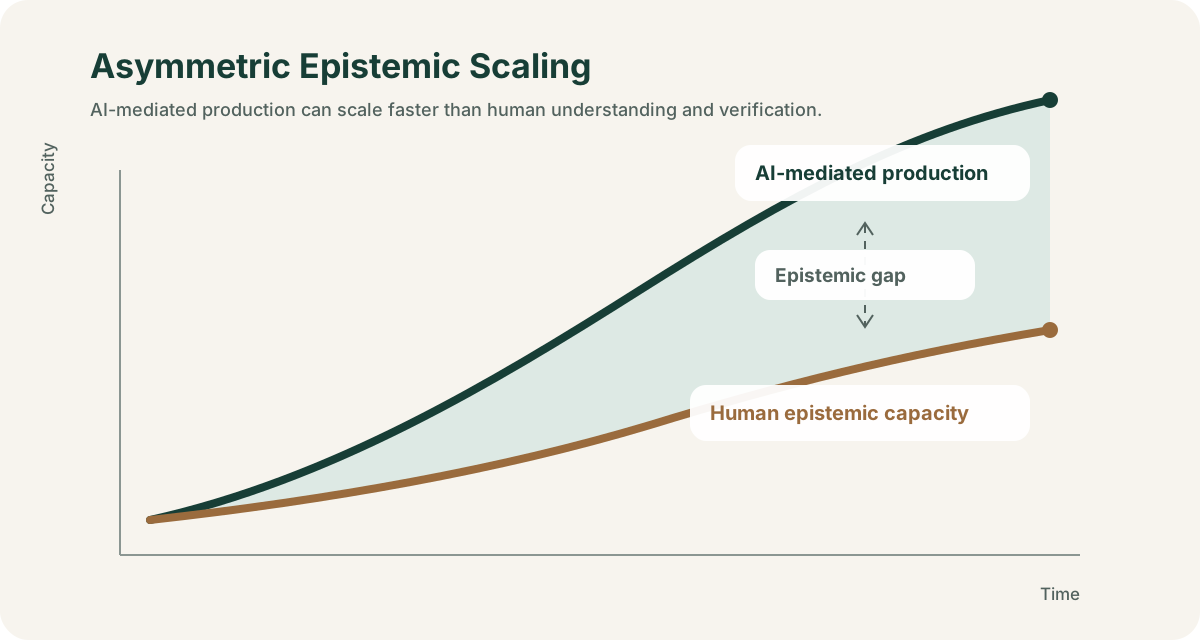
The gap is consequential when the person or organisation responsible for an output cannot reliably determine whether it is accurate, relevant and appropriate for the decision being made. The risk is greater where mistakes can materially affect health, safety, rights, finances or public decisions.
This is not an argument against AI use. It is an argument for locating the new bottleneck correctly. When first-draft production becomes inexpensive, more effort must move towards verification, interpretation and accountable judgement.
What changes in practice?
Using AI responsibly requires more than checking whether an output looks plausible. The workflow must make scrutiny and accountability explicit:
- Which claims require direct verification?
- What evidence supports them?
- Which assumptions were introduced by the model?
- Who is qualified and responsible for reviewing the output?
- Can the person approving it explain its reasoning and limitations?
- Does the amount produced exceed the available review capacity?
The practical objective is not to preserve slow production for its own sake. It is to use machine speed without allowing apparent competence to outrun actual understanding.
AI can increase what an individual is able to produce. Whether that becomes useful knowledge depends on the human and organisational capacity that remains available to examine it.
Status: Conceptual essay. This is not a peer-reviewed paper or an empirically validated model.